
If you’re new here, welcome! This monthly series of “At the Desk” is a repost of my newsletter "Crafting Eden”. You can read my writing updates chronologically by clicking the blog category in the sub-navigation. Or, sign up so that you receive writing news, homestead updates, and opportunities to influence my publishing journey straight to your inbox. Enjoy!
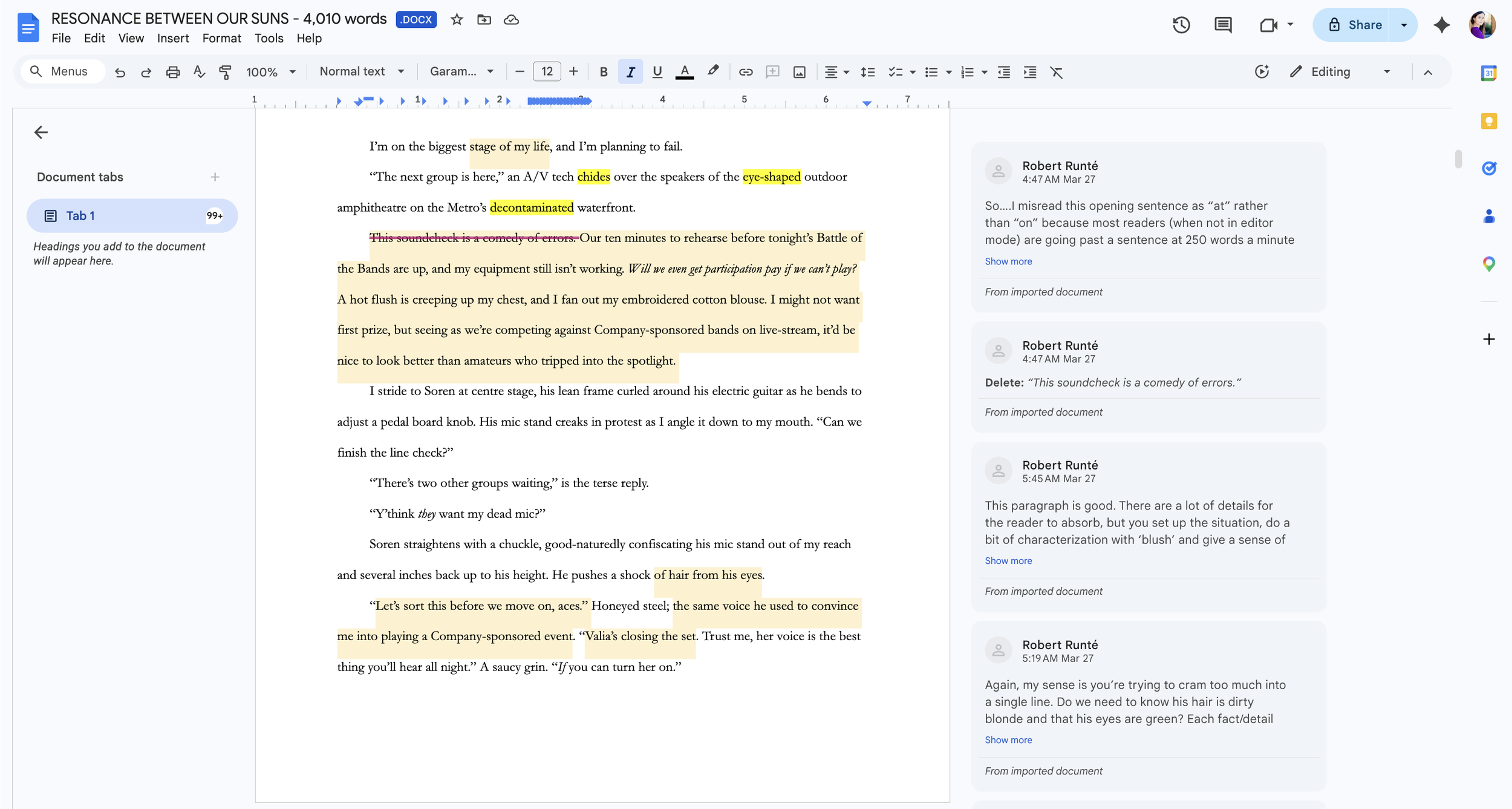
Recently, I hired a developmental editor to read my synopsis and the first 4,000 words of my story (first page is above). These first pages often require multiple rewrites.
Perhaps you've never analyzed the first line or first chapter much, but there is tracked and subtle psychology at work here. My job as a writer is to "hook" without you noticing, "Ah, I see what you did there," or pause because too much/little info is pulling you out of the story.
As I slogged through revisions, I needed some reassurance that this trail I’m forging is not completely off-course.
I’d never paid for an editor before. As many authors do, I had smart friends who read voraciously and can also articulate what’s working or not in a story. Up until now, I’d relied on beta readers and other writers for feedback.
But what I came to realize, is that my frugality on home goods, and groceries, and non-necessities did not have to also extend to my professional development. After a seven-year post-partum hiatus from the Surrey International Writer’s Conference, it was time to invest in my writing.

Through Essential Edits, I connected with Robert Runte, a retired professor and Canadian editor active in the science fiction community. He reviewed my first 4,000 words (Chapter 1 and half of Chapter 2) and a three-page synopsis.
The feedback I received was both a blessing and a burden. Once I had a professional editor pointing out that I’m being “reasonably clever, but still sneaking in too much backstory”, I couldn’t un-see it. I couldn’t power through my draft as planned. I ended up going back to the beginning and got sucked into another revision loop.
Robert pushed me to clarify the message: “What’s the core story here?” When I thought I had articulated it well, he asked for more refinement.
I’m grateful that he never took any halfway explanation at face value. It forced me to get to the heart of my story: a musician who wants to be heard, and is willing to give up everything she loves for a career among the stars…only to realize she must sacrifice her voice and learn to listen, instead.
I realized, too, how important it is to talk about your book with different types of people. Disconnect can be very helpful; even talking to people who don’t normally read your type of writing, or don’t connect with the story, can help you get closer to the story you want to tell the readers who are looking for it.
It wasn’t all pushback. On the plus side, my editor complimented my “solid quality sample”:
“
”I have made just over 100 marginal comments . . . I often have to make four times that number.””
It was gratifying to hear that all my previous years of writing, drafting, revising, attending writer's conferences, studying craft books, reading my genres with a critical eye, critiquing other authors, that now-distant four-year English Literature degree... I may not be a polished, published fiction writer yet, but the pudding is showing some "proof", anyway.
The trick is in the doing, and I've got a lot of doing left.